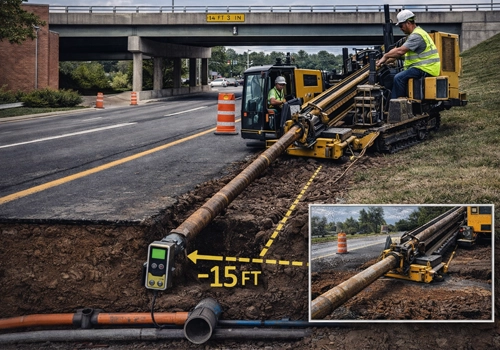
One of the most common questions about trenchless drilling is how deep the installation actually goes. The answer is not a fixed number. Depth is not guessed in the field. It is planned, engineered, and controlled from start to finish based on the conditions of the project.
Directional drilling depth depends on what the utility needs to pass under, what already exists underground, and how the bore path is designed. Every project has different requirements, and depth is one of the most critical factors in making sure the installation is successful.In most cases, this work is part of a broader directional drilling service approach that focuses on controlled installation beneath the surface without unnecessary disruption.
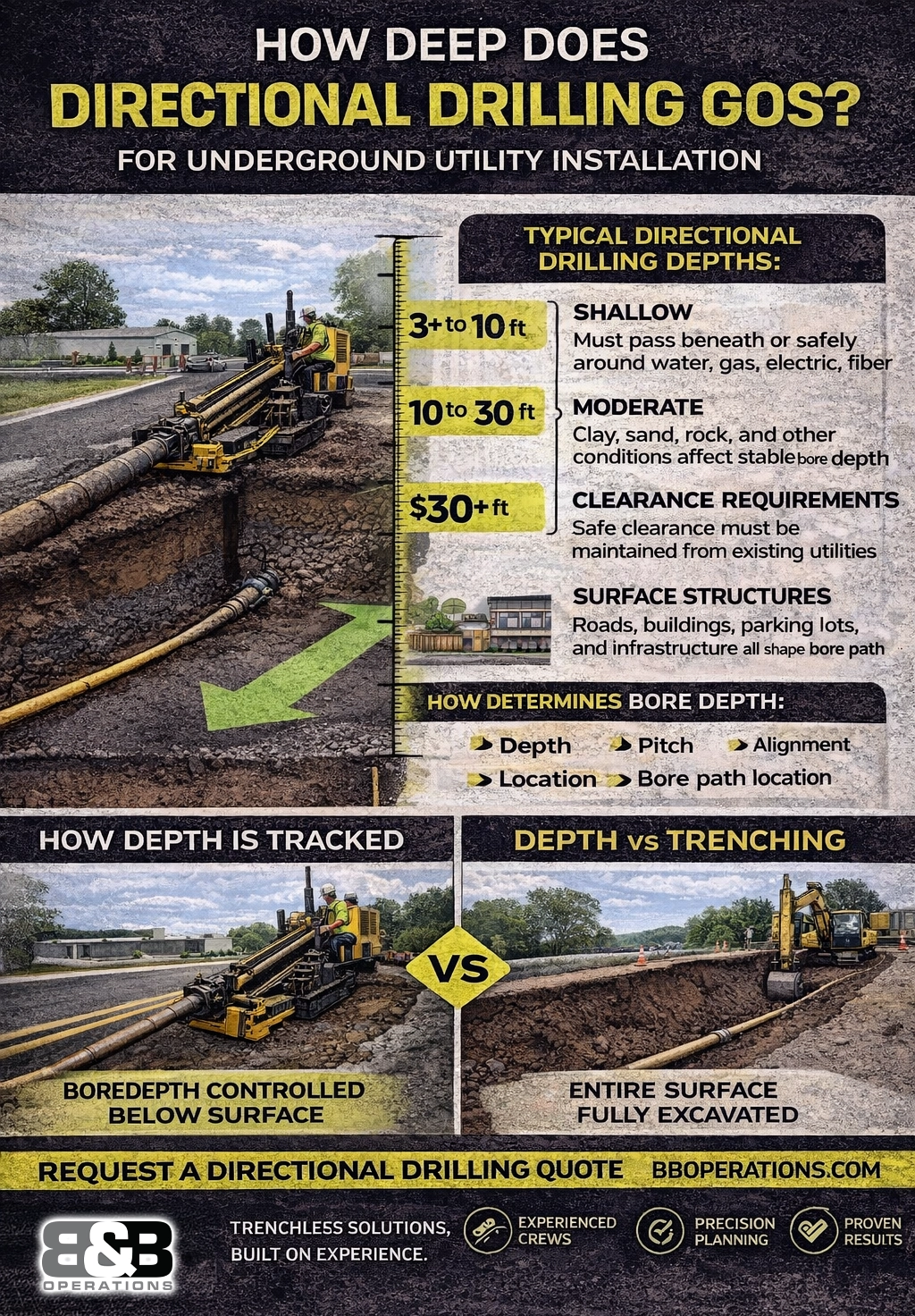
Most directional drilling projects for underground utility installation fall within a general depth range, but that range can vary depending on the job.
These ranges are not limits. They are typical scenarios. Depth is determined by what needs to be avoided and what needs to be protected above the bore path.
Depth is tracked in real time using specialized equipment that monitors the drill head position throughout the bore.
To understand the full process,
see how trenchless drilling works for underground utility installation.
Deeper installations require more planning, control, and time. This directly affects project cost.
For cost breakdown details,
learn how much directional drilling costs and what affects it.
Trenching achieves depth through excavation, while directional drilling achieves it through controlled boring without disturbing the surface.
See the full comparison:
when to use trenchless drilling vs trenching.
Directional drilling depth is engineered, not guessed. Proper planning ensures utilities are installed safely beneath the surface while protecting structures, minimizing disruption, and maintaining long-term performance.
B&B Operations provides trenchless drilling services with precise bore path planning and controlled depth execution for commercial and utility projects.
Talk with our directional drilling team