Before any utility goes underground, the method matters. In developed environments, the real challenge is getting the line installed without tearing up everything above it. Trenchless drilling gives contractors a controlled way to install underground utilities beneath roads, buildings, and active properties while minimizing disruption at the surface.
Trenchless drilling is used to install underground utilities without cutting a continuous trench across the surface. Instead of excavating from point A to point B, a directional drilling rig bores beneath the ground along a controlled path. That allows crews to keep roads intact, reduce restoration, and complete utility installation with greater control in developed areas.If your project involves underground placement in a developed corridor, this work often falls under broader directional drilling services designed to reduce disruption while keeping the job moving.
On an active job site, trenchless drilling follows a controlled, step-by-step process. The work starts with path planning, moves into a pilot bore, continues through bore widening, and ends with utility pullback and installation. Each phase is designed to keep the bore aligned, protect surrounding conditions, and complete the installation without opening the surface between entry and exit points.
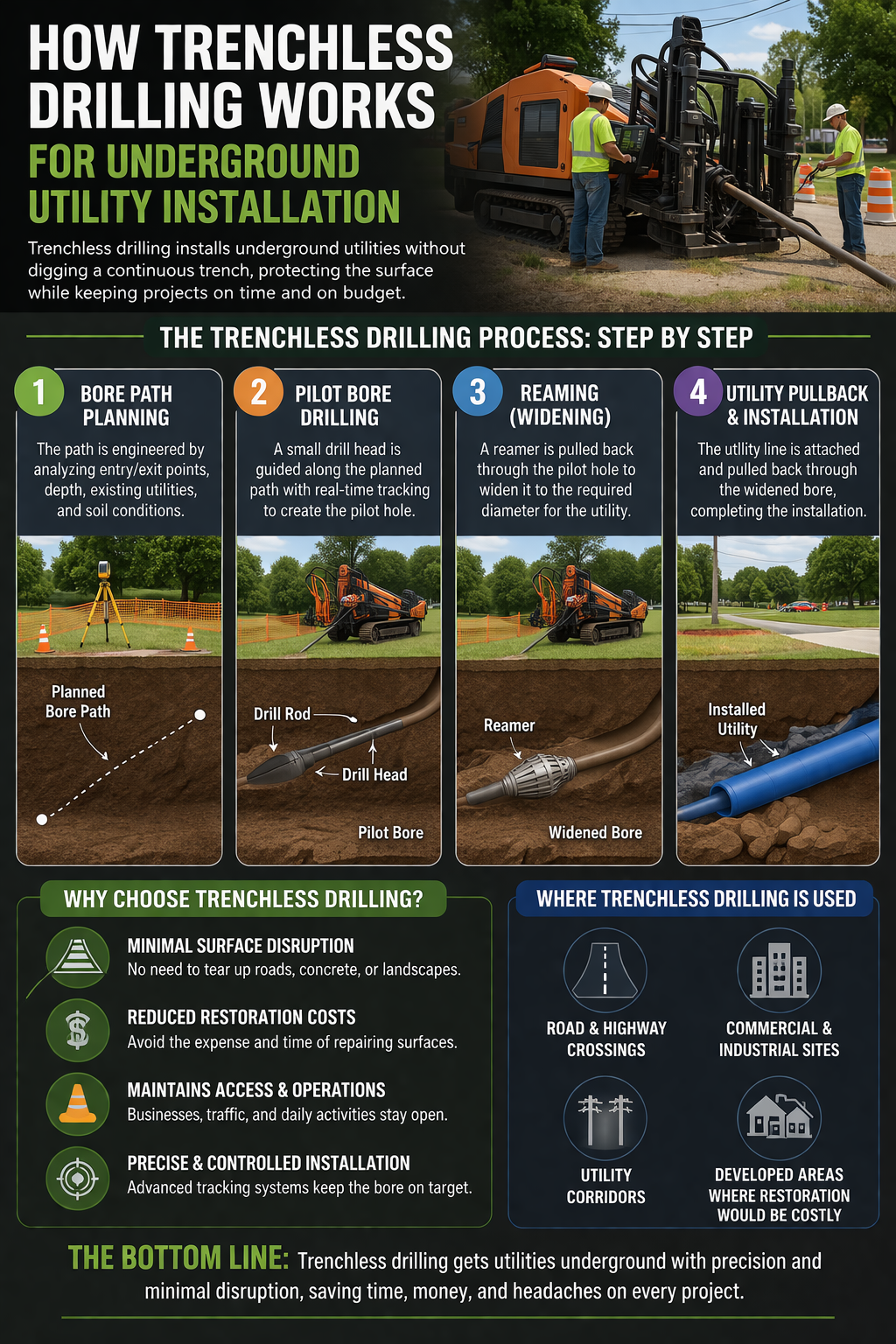
Before drilling begins, the bore path is engineered around entry and exit points, required depth, existing utilities, and soil conditions. This planning stage determines whether the installation can be completed safely and efficiently without creating conflicts underground.
The pilot bore is where the work begins. A drill head is guided into the ground and steered along the planned path using real-time tracking systems that monitor depth, pitch, and alignment. This is where operator experience matters most, because the bore path must stay controlled from start to finish.
Once the pilot bore reaches the exit point, the hole is widened to match the size needed for the utility. A reamer is pulled back through the initial bore, and depending on soil conditions, this may require multiple passes to maintain stability and avoid unnecessary stress on the ground.
After the bore is properly sized, the utility line is attached and pulled back through the completed path. This may include conduit, fiber, water lines, or other underground infrastructure. At no point does the surface need to be opened across the entire run.
Trenchless drilling is most valuable where excavation would create unnecessary cost, disruption, or risk. It is often the better option when roads cannot be removed, businesses need to stay open, or restoration would become a major part of the total project cost.
If you are comparing installation methods, it helps to understand where each one fits.
See trenchless drilling vs trenching for a direct comparison.
No two drilling projects are exactly alike. Soil conditions, bore length, bore diameter, existing underground utilities, and site access all affect how the project is planned and executed. Clay, sand, rock, and mixed ground conditions each require different levels of control and different drilling strategies.
Depth is also a major factor. It is not guessed in the field. It is planned before drilling starts and monitored throughout the installation process.
Learn how deep directional drilling goes and what determines it.
Installation cost alone does not tell the full story. Surface restoration, traffic control, downtime, and surrounding site conditions all affect total project cost. In developed environments, trenchless drilling often becomes the more efficient financial decision once those factors are included.
For a closer look at pricing and what drives it, read more about directional drilling cost and what affects pricing.
Trenchless drilling gives contractors a way to install underground utilities with control, accuracy, and minimal surface disruption. In the right setting, it protects roads, preserves access, reduces restoration, and keeps the project moving without creating unnecessary problems above ground.
If your project runs beneath a road, structure, or active property, the method matters just as much as the installation itself.
B&B Operations provides trenchless drilling services for commercial, municipal, and utility projects across Central Illinois. Our team plans every bore path with precision, executes with control, and keeps your project moving without unnecessary surface disruption.
Speak with our directional drilling team